WORKFLOW / ROUTING / APPROVALS / OPERATIONAL CONTROL
Workflow automation that keeps business operations moving.
Jenrix engineers workflow automation systems that turn fragmented manual coordination into structured process movement across tasks, approvals, reminders, escalations, ownership and connected-system actions.
We design the operating logic beneath the workflow: what starts the process, who owns each stage, which rules change direction, when approval is required, what happens when work stalls and how execution remains visible.
ROUTING ACTIVE APPROVAL CONTROL SLA MONITORED SYSTEM CONNECTED
JENRIX / WORKFLOW CONTROL ENGINETrigger → Route → Approve → Execute → Monitor
WORKFLOW ACTIVEITEMS126 ACTIVE
ROUTINGAUTOMATED
APPROVALSCONTROLLED
SLAMONITORED
STATUSVISIBLE
JENRIX COREFLOWRULES / OWNERSHIP / CONTROL
LIVE WORKFLOW EVENTREQUEST RECEIVED / OWNER RESOLVED
WORKFLOW SYSTEM01
Process discipline should live inside the system.
When routing, ownership, approvals, timing and exceptions are encoded into the workflow, execution becomes less dependent on memory, messages and constant manual supervision.
Triggers & RulesOwnership & RoutingApprovals & TimingExecution Visibility
WHY WORKFLOWS BREAK
Processes fail when the next step depends on somebody remembering it.
Manual coordination creates invisible queues, missed approvals, unclear ownership and inconsistent follow-up. Workflow automation moves these responsibilities into the operating system.
The process exists, but movement is unreliable.
- Assignments depend on messages and memory
- Approvals wait without clear escalation
- Ownership becomes unclear between stages
- Managers chase status manually
- Bottlenecks appear after outcomes are affected
Movement, control and accountability become system behavior.
- Events trigger structured process movement
- Rules determine routing and ownership
- Approvals and exceptions remain explicit
- Timers create reminders and escalation
- Status and cycle time remain observable
WORKFLOW AUTOMATION CAPABILITIES
One control layer. Every important movement accounted for.
Jenrix structures automation around process stages, business rules, roles, timing, exceptions and the systems that participate in execution.
Task Routing & Assignment
Auto-assignment, queue movement, ownership transitions and workload distribution.
Approval Automation
Multi-step review, authorization, returns, rejections and sign-off logic.
Reminders & Escalations
Deadline monitoring, inactivity alerts, follow-up prompts and exception escalation.
Triggers & Rules
Event-driven actions, status rules, dependencies and conditional movement.
Workflow Tracking
Pending items, ownership history, stage visibility and execution transparency.
Operational Analytics
Cycle time, bottlenecks, response performance and workflow-level reporting.
Exception Handling
Explicit paths for failures, missing information, returns and human intervention.
System Integration
CRM, ERP, portals, APIs, messaging and internal applications connected to flow.
WORKFLOW REFERENCE
Automation should show how work moves.
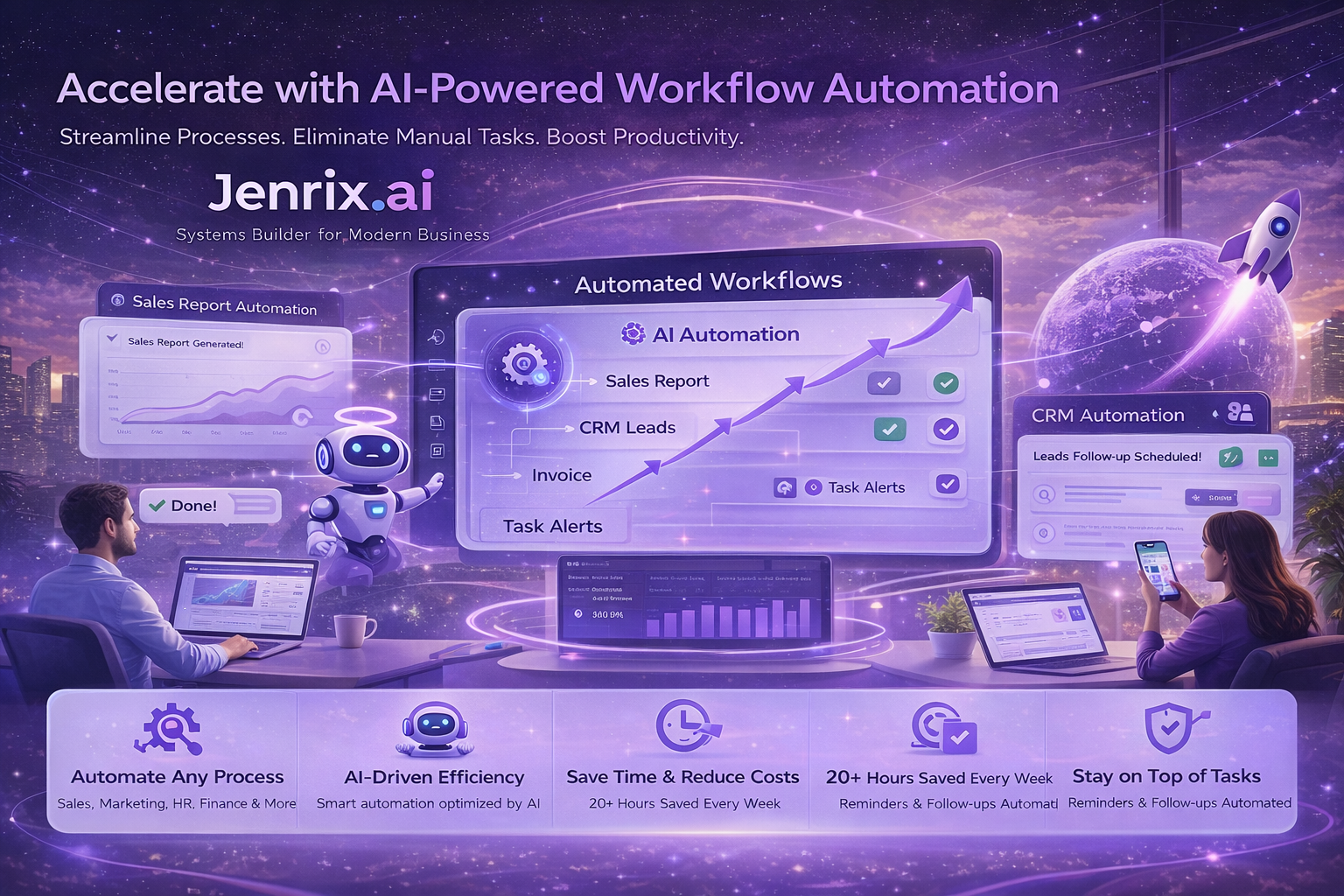
Your existing workflow visual remains a supporting reference; the live architecture above explains the actual control model.
JENRIX / WORKFLOW AUTOMATION REFERENCE
WORKFLOW AUTOMATION USE CASES
Automate processes where delay, ambiguity or repetition has a cost.
Approval-Driven Operations
Requests, documents and internal actions moving through controlled review chains.
Sales & Follow-Up Movement
Leads, deals, callbacks and tasks progressing through defined sequences.
Back-Office Processes
Admin, support, finance and operations workflows with multiple dependencies.
Multi-Team Workflows
Structured handoffs, status updates and accountability across departments.
Request & Ticket Movement
Operational requests and service items routed through controlled execution.
Time-Sensitive Processes
Processes where inactivity, pending approval or missed action affects outcomes.
WORKFLOW OPERATING MODEL
Reliable automation aligns events, ownership, rules, time and action.
WORKFLOW AUTOMATION FAQ
Questions before automating operational movement.
What is workflow automation?+
Workflow automation uses defined triggers, rules, ownership, routing, approvals, reminders and system actions to move business work through repeatable process stages with less manual coordination.
Can Jenrix automate approval workflows?+
Yes. Multi-step approvals, authorization rules, returns, rejections, reminders, escalations and audit visibility can be engineered into the process.
Can workflows connect with CRM, ERP and APIs?+
Yes. Jenrix can connect workflows with CRM, ERP, portals, dashboards, messaging, APIs and internal applications where the process requires them.
RELATED JENRIX ENGINEERING
ENGINEER OPERATIONAL FLOW
If process speed matters, the next step should not depend on memory.
Jenrix can map your workflow, ownership, approvals, rules, exceptions and integrations, then engineer the automation layer around reliable execution.