Software that waits for people to keep it accurate.
- Manual ownership and inconsistent lead routing
- Follow-ups depend on individual memory
- Communication history remains fragmented
- Pipeline stages become subjective
- Managers stop trusting dashboards
Jenrix designs CRM and revenue systems that connect lead capture, assignment, follow-up, communication, pipeline movement, automation, dashboards and management visibility.
Instead of treating CRM as a database for contacts, we structure it as an operating system for how your business acquires, qualifies, follows up, converts, retains and understands customers.
For Jenrix, CRM engineering means creating a connected operating environment for lead intake, qualification, assignment, follow-up, communications, stage progression, reporting and management control.
CRM implementations fail when the software records activity but does not control ownership, response expectations, follow-up discipline, pipeline rules, communication context or management visibility.
The platform is shaped around how your business sells — not around a generic feature checklist. Each layer contributes to a more controlled and measurable revenue operation.
Website forms, paid campaigns, portals, referrals, imports and manual enquiries connected into structured intake.
Territory rules, round-robin, team ownership, priority queues, reassignment and escalation logic.
Defined stages, movement conditions, values, probabilities, lost reasons and conversion checkpoints.
Callbacks, meetings, tasks, reminders, missed-action alerts and next-step discipline across the team.
Conversation history, templates, sequences, notes, interaction timelines and communication visibility.
Response time, source performance, conversion, pipeline value, team productivity and management dashboards.
Automatic assignments, status rules, notifications, inactivity controls, task generation and workflow orchestration.
Lead scoring, summaries, next-step suggestions, communication intelligence and management decision support.
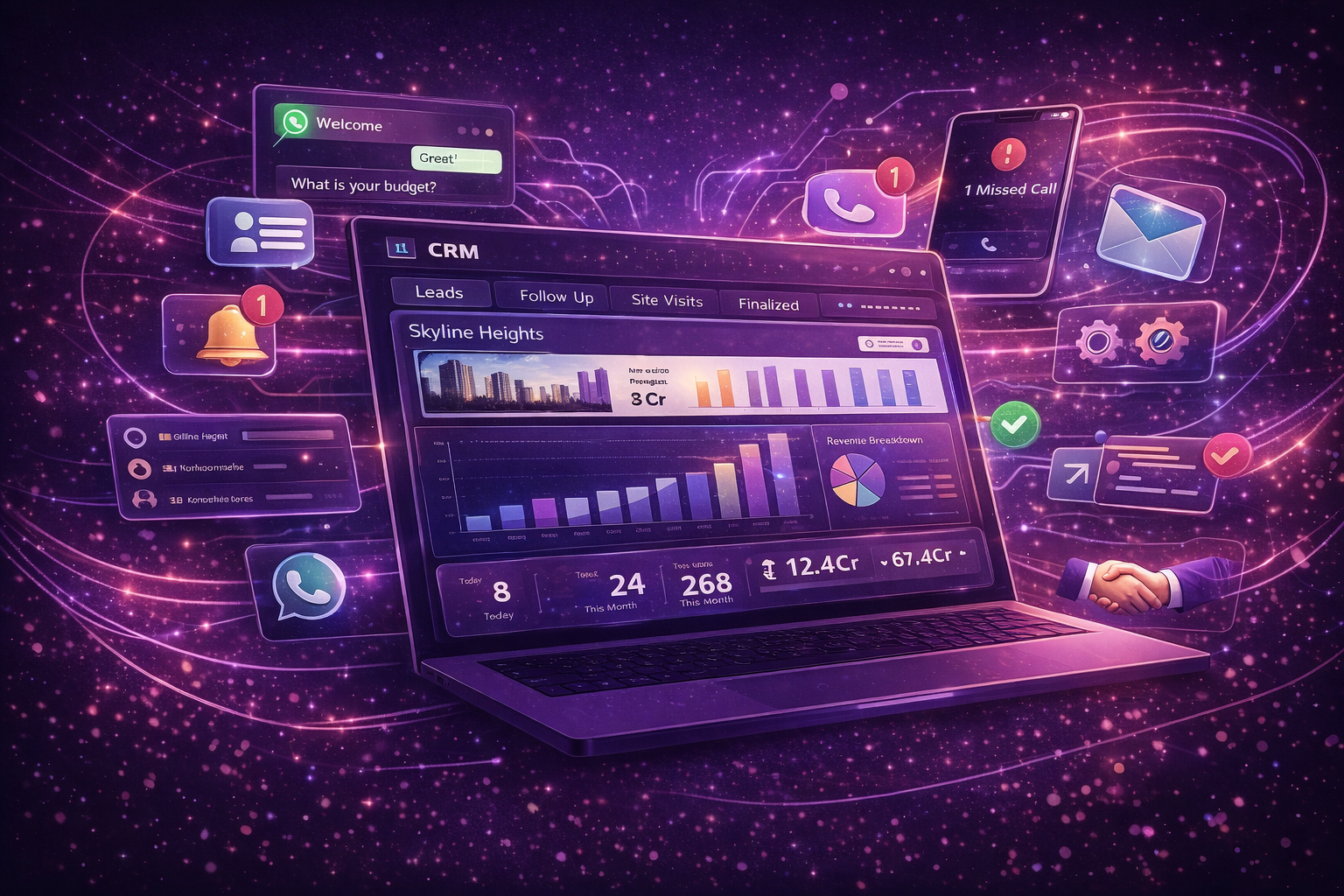
Your existing Jenrix revenue visual is retained as a supporting reference, while the live console above explains the system architecture dynamically.
Jenrix can structure the CRM around transaction volume, sales complexity, team structure, campaign channels, customer lifecycle and management controls.
For businesses handling continuous website, portal, advertising or enquiry-led lead flow.
For opportunities requiring discussions, meetings, site visits, proposals and decision checkpoints.
For organizations needing assignment control, accountability and manager visibility across sales teams.
For onboarding, account management, service follow-up, renewals and customer communication beyond the first sale.
For businesses connecting paid media, WhatsApp, email, landing pages and outbound programs into revenue workflows.
For real estate, education, healthcare, professional services, distribution and specialized operational models.
Clear answers for founders, sales leaders and operations teams evaluating custom CRM or revenue infrastructure.
A CRM and revenue system is the operating layer that manages lead capture, ownership, pipeline movement, follow-ups, communications, sales activity, automation, dashboards and revenue visibility.
Custom CRM becomes relevant when generic tools no longer reflect your sales workflow, ownership rules, automation needs, customer lifecycle, reporting requirements or integration environment.
Yes. CRM architecture can connect communication channels, marketing sources, ERP systems, payment services, APIs, reporting infrastructure and other operational platforms where appropriate.
Yes. AI can support lead scoring, summaries, next-step suggestions, communication intelligence, inactivity alerts, document interpretation and decision support without replacing the underlying revenue process.
We can map your current revenue process, identify control gaps and engineer a CRM platform around the way your business actually needs to acquire, follow up and convert customers.