LEAD CAPTURE / ROUTING / FOLLOW-UP / REVENUE CONTROL
Lead automation built for speed, ownership and conversion discipline.
Jenrix engineers lead automation systems that connect capture, qualification, routing, response timing, follow-up, reminders, communication triggers and pipeline visibility into one structured revenue process.
The objective is not simply to collect enquiries. It is to reduce the time between lead arrival and meaningful action, keep ownership clear, make follow-up consistent and give managers visibility into how leads move toward conversion.
RESPONSE SPEED
SMART ROUTING
FOLLOW-UP CONTROL
CONVERSION VISIBILITY
JENRIX / LEAD FLOW ENGINE
Capture → Qualify → Route → Follow Up → Convert
LEAD FLOW ACTIVE
LEADS133 ACTIVE
ROUTINGAUTOMATED
FOLLOW-UPCONTROLLED
PIPELINEVISIBLE
AIASSISTED
JENRIX CORE
REVENUE
CRM / AUTOMATION / DATA / AI
LIVE LEAD EVENT
NEW LEAD / OWNER RESOLVED
LEAD AUTOMATION SYSTEM
01
Lead speed matters most after the enquiry arrives.
Good acquisition can still underperform when assignment, response, follow-up and ownership rely on manual coordination. Lead automation places those movements inside the system.
Capture
Qualification
Routing
Follow-Up
WHY LEAD HANDLING BREAKS
Most lead systems fail between capture and follow-up.
Businesses may generate enquiries successfully but still lose opportunities through slow assignment, unclear ownership, weak prioritisation and inconsistent response.
Leads enter the business, but movement remains inconsistent.
- Assignments depend on messages and manual distribution
- High-value enquiries are not always prioritised quickly
- Follow-up relies too heavily on individual memory
- Managers see problems after leads have already gone cold
- Source performance becomes difficult to evaluate accurately
Lead movement becomes structured system behaviour.
- New enquiries enter a consistent capture layer
- Qualification signals support priority and routing
- Ownership resolves immediately through defined rules
- Follow-up tasks, reminders and communication are triggered
- Pipeline movement and response performance remain visible
LEAD AUTOMATION CAPABILITIES
One lead system. Every movement connected.
Jenrix structures lead automation around acquisition sources, qualification logic, ownership, response, communication, CRM movement and management visibility.
Lead Capture Automation
Website forms, landing pages, paid campaigns, referrals, imports and portal sources connected into structured intake.
Lead Qualification Logic
Intent indicators, scoring, source weighting, tags, business-fit rules and prioritisation signals.
Routing & Assignment
Team, territory, department, source, workload, queue and round-robin assignment logic.
Follow-Up Automation
Calls, reminders, callbacks, tasks, inactivity flags and next-step sequencing.
Communication Triggers
Acknowledgements, message sequences, response prompts and communication actions around lead stages.
Pipeline Tracking
Status movement, stage visibility, ageing, stalled leads and conversion progression.
Lead Performance Analytics
Response time, source quality, follow-up completion, conversion movement and team performance.
CRM & System Integration
CRM, dashboards, campaign sources, messaging services, APIs and operational systems connected to the lead layer.
LEAD AUTOMATION REFERENCE
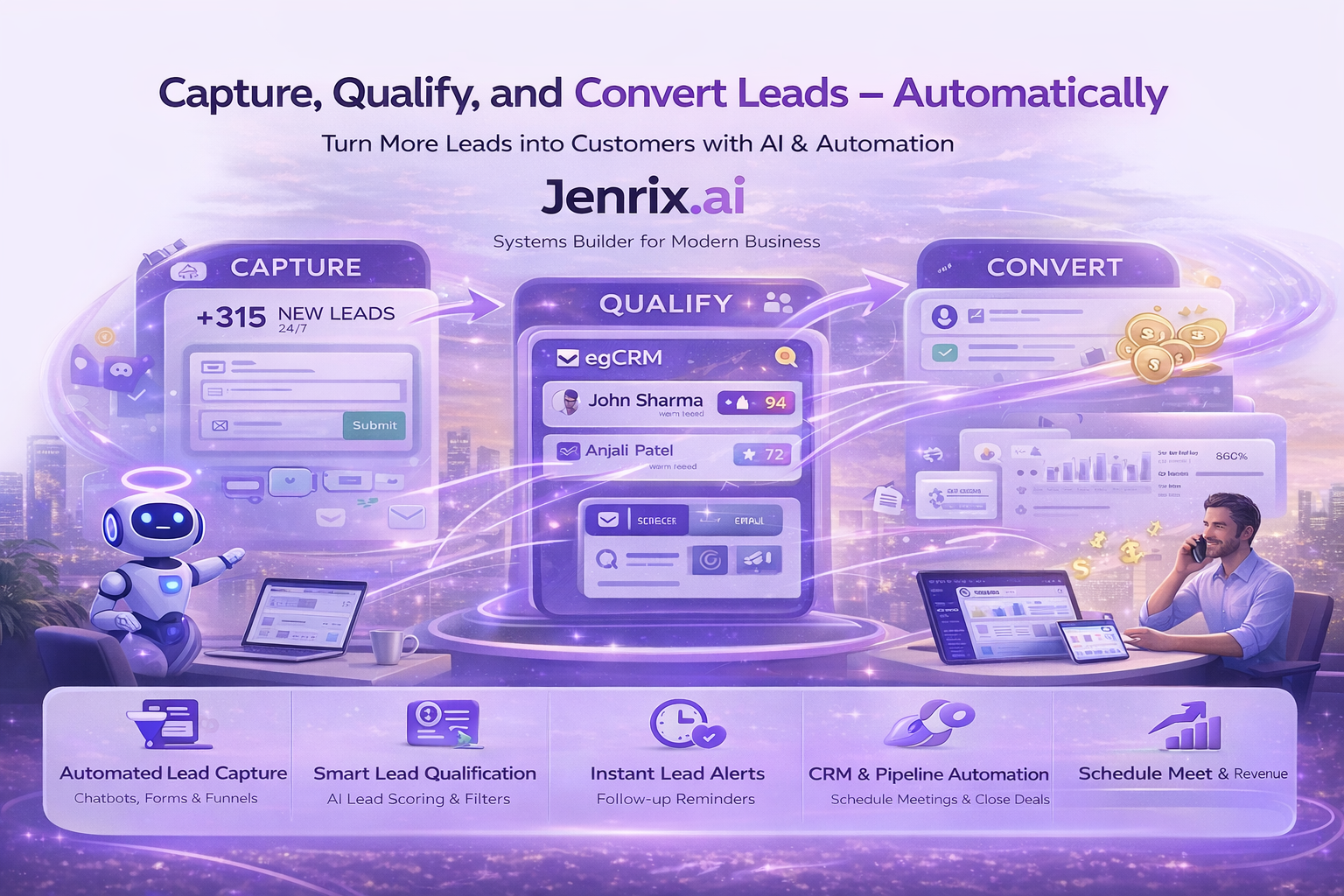
The visual should explain how leads move through the revenue system.
Your existing lead-automation visual is retained as a supporting reference, while the live system above explains routing, follow-up and ownership more clearly.
JENRIX / LEAD AUTOMATION REFERENCE
LEAD AUTOMATION USE CASES
Different acquisition models require different lead-flow logic.
Campaign Lead Automation
Paid campaigns, landing pages and acquisition funnels routed into structured follow-up.
High-Volume Enquiry Handling
Fast distribution, queue control, SLA monitoring and clear ownership for large lead volumes.
Sales Team Distribution
Structured routing across agents, managers, regions, teams and territories.
Multi-Channel Capture
Website, calls, forms, imports, portals, campaigns and integrations entering one lead system.
Response-Time Sensitive Sales
Lead models where fast contact materially affects qualification and conversion.
Lead Quality Visibility
Source quality, team response, conversion efficiency and lead readiness measured clearly.
LEAD OPERATING MODEL
Better conversion comes from better lead movement.
LEAD AUTOMATION FAQ
Questions before automating lead movement.
What is lead automation?+
Lead automation uses structured capture, qualification, routing, follow-up, reminders, communication triggers and CRM movement to reduce response delays and improve consistency across the lead lifecycle.
Can Jenrix automate lead assignment and follow-up?+
Yes. Jenrix can engineer assignment rules, territory routing, queues, round-robin logic, follow-up tasks, reminders, inactivity alerts and communication triggers around the lead process.
Can lead automation connect with CRM and dashboards?+
Yes. Lead automation can connect with CRM systems, dashboards, campaign sources, communication services, APIs and revenue workflows where the operating model requires them.
RELATED JENRIX ENGINEERING
ENGINEER BETTER LEAD MOVEMENT
If lead response matters, the system should move before the lead goes cold.
Jenrix can map your acquisition sources, qualification logic, assignment rules, response expectations, follow-up sequences and reporting needs, then engineer the lead automation layer around consistent revenue execution.